No man of truth ever contemplates the consequences. These are the people: Socrates, Mansoor and Jesus, who have raised the human consciousness by sacrificing themselves. They knew perfectly well that to say the truth was inviting death, but death does not matter to the man of truth. He knows there is no death – the body dies, but your consciousness remains always.
Truth has to be pure, uncontaminated, unpolluted, without any fear of any consequences – only then can it help humanity. Perhaps it may be dangerous for the man who utters it, but it is worth it. To be sacrificed for truth is one of the great blessings, one of the greatest ecstasies.
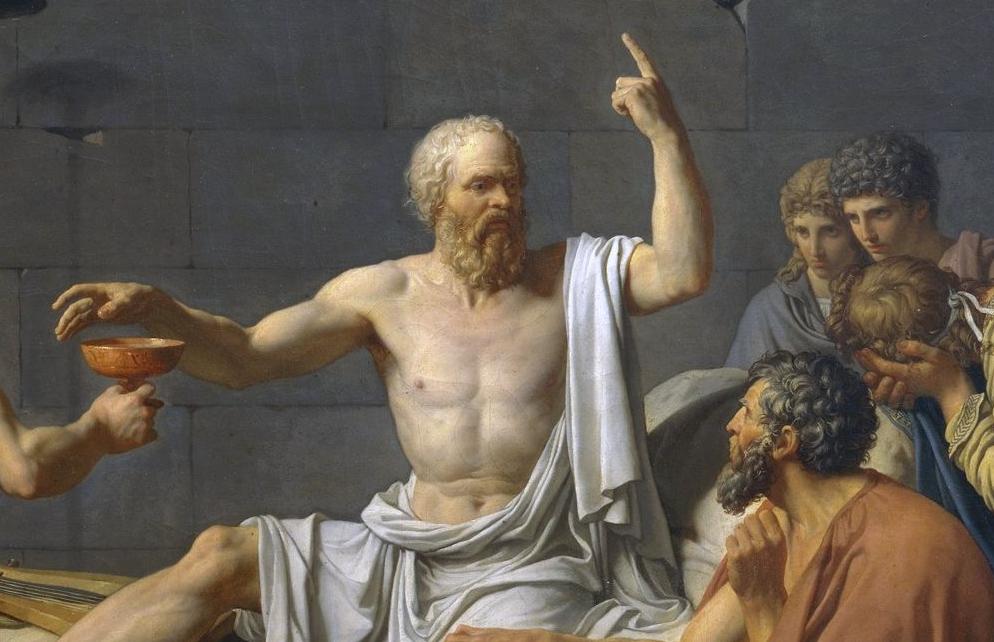
Socrates was a Greek philosopher, who lived during a period of untold atrocities, amidst the experiences of death, war, and disease in ancient Greece. Socrates guided the masses with a more realistic perception of the world through a deep-inquiry in the true nature of our very existence. He realized that the master key to attain true wisdom is to first admit one’s ignorance of things in life, to admit that one knows absolutely nothing about existence followed by an inquiry into our true nature.
Socrates does not believe in any God, but he does not say that there is no God. He is very scientific. He says, “As far as I have enquired, there seems to be no God, but who knows about the results of further enquiry? Take it as a hypothesis that there is no God, but if some day you discover God, hypotheses can be changed. Socrates does not say that life survives after death. He says, “I will have to wait and see. When I die, only then can I see whether life survives after death or not, because nobody has come back from death and told us that life survives.” And never forget that this was twenty-five centuries ago. This man had such courage that when poison was given to him, he gathered all his disciples and said, “You have always been asking about whether life survives or not. This is a good chance, a great opportunity. If I had died an ordinary death then there would have been no opportunity. But now poison will be given to me” — and poison kills very slowly — “so I will report to you to the very last moment, till my tongue also becomes numb and I cannot say anything.”
Twenty-five centuries ago it was even more difficult, because in every country there were messiahs, prophets, messengers of God, sons of God. In that climate the man’s humbleness was really surprising and made him one of the most respected human beings who have ever walked on the earth.
When Socrates was poisoned, Athens was a city state, a direct democracy. Every citizen except the slaves had the right to vote and every decision was to be made by the whole city. The chief justice who was going to decide whether the majority of Athenians were in favor of poisoning Socrates or in favor of saving him, was puzzled. The whole of Athens was shouting, ”Socrates has to be killed because he is destroying our morality, he is destroying our religion, he is corrupting the mind of our youth and we cannot tolerate it anymore.”
The day Athens chose to poison Socrates, it poisoned the whole Greek spirit. It has never again risen to the same heights. Twenty-five centuries have passed, but not a single man has been able to reach to the same glory, to the same light, the same insight. Killing Socrates, Greece committed suicide. And it can be seen easily. If they had listened to Socrates rather than poisoning him, and had dropped their conditionings, which he was asking them to do, Greece would have been at the very top of the world today in intelligence, in consciousness, in the search for truth.
The Chief Justice must have been a man of some intelligence. He saw that Socrates was a simple, innocent, almost childlike person. He had not committed any crime, he had not done any harm to anybody. And that’s what Socrates had appealed to the court — “Just tell me, what is my crime?”
There was no crime, there was no charge against him. The chief justice whispered in his ear that “Your crime is that you are a natural being. I cannot say it aloud, because I know if they cannot forgive you, they cannot forgive me either. But I have immense respect for your innocence and I don’t want a man like you to be destroyed. You are an exception, but you prove the rule that every man can be so innocent and so sincere and so alive and so joyous. I give you three alternatives….
“First is that Athens is a city state; its laws are not applicable outside the boundary of the city. The simple thing is for you to move outside the city. You can open your school, your academy, and those who love you will be coming there. And I know for certain that the younger generation is immensely impressed by you. It is the older generation…”
But in the past, the older generation was always the majority, because out of ten children, nine used to die within two years after their birth. Now the situation has reversed: out of ten children only one child dies, nine go on living. It is for the first time that young people are the majority in the world. Never in the past were the young people in the majority. They were always a minority group.
The chief justice said, “You simply move out of the city.” Socrates said, “That will be cowardly. As far as death is concerned, it is going to come sooner or later. I am already old enough. But I don’t want the future generations to remember that Socrates moved out of Athens because of the fear of death. Please forgive me, I cannot go out of Athens.”
The chief justice said, “Then the second simple thing will be that you stop teaching. Live in Athens, but don’t talk about your truth. And don’t talk about people being sincere and authentic.”
Socrates said, “You are asking me to do things which I cannot do. What is the purpose of my living if I cannot blossom into my absolute potential? When a tree blossoms, flowers are bound to be there and the fragrance is going to reach those who are receptive. I will continue to speak and I will continue to talk about truth and I will continue to provoke people to be natural and not to become hypocrites according to the so-called religions.”
The chief justice said, “Then I am helpless. Then the third alternative is that you have to accept poison. Because the majority, although they have no evidence against you, simply say that your very presence is corruptive. Your very presence is destroying the youth; your very presence is taking the youth away from the old path trodden by the ancients. Your presence is making individuals assertive, giving them courage to be free and to stand alone even if it comes to be against the whole society.”
Unwillingly, in spite of himself, the chief justice had to give him the death sentence, death by poison.
Do you think Socrates was not intelligent? Alternatives were offered: He could have moved out of Athens – but truth knows no compromise. He could have stopped teaching; he was already very old. But when you are pregnant with truth, you cannot stop teaching. You have to say it to those who are blind, who are deaf, and who are living in all kinds of lies.
He preferred to die. He said to the chief justice, ”Remember, I am choosing death in favor of truth. And because of this death, whatever I have been teaching will remain for centuries. Even the names of your judges, and you, will be forgotten. Nobody will know this crowd who is shouting to kill me, but my death will make it a guarantee that even after my death, my words will go on improving human consciousness.”
Socrates said, “There is no problem about poison. That I can accept. I am dying for a beautiful cause. I have lived in absolute glory and I am dying with a crescendo.”
The sentence was given that exactly at sunset Socrates should be given the poison. He looked from the window and he said, “The sun has set! The man outside who is preparing the poison — tell him that he is late and he should never be late when he is on duty.”
And while he was lying in the bed and the poison was being prepared, the man – who had prepared poison for many other prisoners — was trying to delay, because he also felt, “The man is absolutely innocent. If I can give him a few minutes more to live… I am a poor man, I cannot do anything more.” So he was preparing the poison as slowly as possible.
But Socrates would come to the door and say to the man, “You are not being sincere, you are cheating. The orders are that as the sun sets, the poison should be given to me. And the sun has set and you have not prepared the poison. I feel you are trying to give me a few more minutes, but there is no point. I am ready to go into the unknown. Life I have known enough. Don’t delay; let me go into the unknown mysteries of death.”
He was one of the sincerest men in the sense that he never said anything about what happens beyond death. He always said, “First let me die. Unless I know, I cannot say anything about beyond death. Those who have said something are all lying, deceiving, cheating, because they are still alive and they don’t know anything about death. Don’t force me to be in the same company. I will say only that which is my experience.”
He told the man preparing the poison, “Be quick, because my disciples are waiting. Perhaps I can give them a few indications about death as it is experienced.” The poison was given — and this is when Socrates came into his purest awareness.
He took the poison. Then he said, ”My legs are feeling numb. It seems the poison has begun to work. Now the poison was coming up.” He went on relating. He was a keen intellect. Even in death he was experimenting. He was a scientific thinker.
He said to his disciples, “Up to my knees, I don’t feel.” He pinched and he said, “Up to my knees, the poison has worked. But one thing you should remember: the knees are gone, but I am as complete and entire as I have been before. Nothing has been taken away from me.”
He said, ”Now the poison is coming up. Now half of my body is dead.” He was a rare man. He was not ordinary. Then he says, “Half of my body, the lower half, is dead, but I am completely whole; half of my consciousness is not dead.”
Then he said, “My hands are becoming numb, my eyes are drooping, and I can feel that my tongue will stop any moment, so this is perhaps the last statement I have to make to you — that life survives after death, because I can see death happening. Parts of my body are dead and I am fully alive. Nothing is missing. So I am certain that when my tongue stops, my eyes close, and my heart stops, it is not going to matter. But don’t believe me; it is just a hypothesis for you. When you die, try it.” Such a scientific spirit!
The disciples were weeping, so he said, ”Stop! You can weep later on. Look at this phenomenon, this progressing poisoning. Soon. I think, my heart will be affected. And I wonder if, after my heart is affected, my mind will work. So now it will be decided whether the heart is the main centre or the mind.” He was a very keen mind, and he was observing, relating.”
When his heart was affected, he said, ”I feel that my heart is sinking, going down. Soon I think I will have feel, but I will not be able to relate anything because my tongue is getting numb, dead. Friends, now there will be an experience which I will be able to experience but which I will not be able to relate. It will be inexpressible because my tongue is going dead.”
And then the breathing started slowing. And Socrates said, “Perhaps I may not be able to say anything more. I want you to know that almost my whole body is dead. Just the last few breaths more… and I will be gone. But I am as entire and as total and as whole as I have ever been. My awareness is crystal clear.”
Even up to the last, his eyes were saying something, relating something. In the last moment someone asked him, ”Socrates are you not afraid of death?”
He said, ”I am not afraid for two reasons.” This was a logical mind. He said, ”For two reasons I am not afraid. One: either Socrates is going to die completely; then there will be no one to be afraid. Or, Socrates is not going to die at all and the soul will live, so why be afraid? These are the two reasons why I am not afraid. Either I will die, really, as atheists say. Materialists say that there is no soul, and they may be right. If they are right, then why be afraid? I will be dead completely, and no one will be there to suffer death, no one will be there to be afraid of anything. Socrates will be no more, so why be afraid?
This shows the sincerity of the man. Only such a man can say that your sources of life belong to eternity, they do not die with your bodies. They only change houses. You have been here always, and you will be here always. You are part, an essential part, inseparable part of this immensely beautiful dancing existence.
This is the man of individuality, who does not care for his life, for his body, who has no fear. He accepted death with joy. There have been great people on the earth, but Socrates has something unique. There is Gautam the Buddha, Lao Tzu, Chuang Tzu — in Greece itself there has been Pythagoras, Heraclitus; in Persia, Zarathustra… and many others, but none of them had a certain quality which only Socrates had. And that is a scientific approach about everything — and that was his crime. And you are all being benefited by science all over the world, not knowing that Socrates sacrificed himself for the same scientific enquiry.
He asked only one thing: that nothing should be believed. Everything should be experienced, experimented with, and unless there is evidence, evidence without exception, it should not be accepted. Even when you accept a thing as truth, if you are honest, accept it only as a hypothetical truth, because who knows? — Tomorrow there may be new facts known, and you will have to change the truth.
People who were not afraid of death, we have killed. And these were the people who had known life; that’s why they were not afraid of death. Deep down they had known that there is something that is going to continue, but they didn’t have any proof, any evidence. Hence Socrates would not say it; he would say it only when the evidence was there. Such devotion to the scientific spirit! That’s why no religion has been created after him.
And my effort is that the future religion should be nothing but a science. Just as there are other sciences — they are the sciences of the objective world — there should be one more science, of the inner, subjective world. There is no space or scope for any religion at all. The scientific spirit is capable of revealing the truth of the object and it is capable of revealing the truth of the subject, of your interior.
I have loved Socrates much more than anyone else — for his humbleness, for his scientific enquiry, for not creating a religion, not creating a theology, not creating a following, not becoming a prophet… Socrates was far more sophisticated, as cultured as you can imagine. The temptation must have been there to proclaim himself a god, and by that proclamation he might have been worshiped and not poisoned. The same people who killed him would have worshiped him; they would have made churches, and they would have still been worshiping him. It needs immense courage when you have such consciousness, such clarity, to remain humble and just human — knowing perfectly well that this is the way to death. Sooner or later these same people were going to kill you, these people whom you are trying to make free from all fetters. Still Socrates chose to remain human. That’s why you don’t see any religion after Socrates, no church, no theology, no holy scripture.
But the man did a great service: he made it clear that your so-called prophets and messiahs are pretenders. And you are such that you get into the traps of pretenders very easily, because they strengthen your conditioning; they help you to remain in your prison. And they call your prison by good names, so you are happy. With a man like Socrates, you are not happy because he says exactly what the situation is — that you are a prisoner, and you have to come out of it. People are lazy; people want not to change. People simply want consolations. Somebody should come as if he is from somewhere higher, coming from God himself to tell them, “You are perfectly right — just go on believing in God. Go on praying to God every night for two minutes, and everything is perfectly okay with you.” This you enjoy, because it saves you all the trouble of change.
People like Socrates seem to be very dangerous because they go on hitting hard on your consolations: they take away all your conditionings; they expose you to your reality. Their work is surgical. It hurts, it is painful, but that is the way A NEW MAN CAN BE BORN.
Just be natural so that you can remain in tune with existence. So that you can dance in the rain and you can dance in the sun and you can dance with the trees, and you can have a communion even with the rocks, with the mountains, with the stars.
Except this, there is no enlightenment.
Let me define it: Enlightenment is to be in tune with existence. To be in tune with nature — the very nature of things — is enlightenment. Against nature there is only misery — and misery created by yourself. Nobody else is responsible for it.
Osho: Om Mani Padme Hum: Chapter #11: Chapter title: The very nature of things (excerpts)
Osho: The Razor’s Edge: CHAPTER 28. TRUTH: THE GREATEST SURGERY (excerpts)
Osho, The Great Pilgrimage – From Here to Here, Ch 1, Q 1 (excerpt)
Osho: The Ultimate Alchemy, Vol 1: CHAPTER 18. THE LIGHT OF AWARENESS Q 2 (excerpts)
Osho: Socrates Poisoned Again After 25 Centuries Chapter #1: I belong to the whole world Q 2 (excerpts)
कतरा रहे हैं आज के सुक़रात ज़हर से
इंसान मस्लहत* की अदाओं में खो गया………….कामिल बहज़ादी
(* स्वार्थ देख कर निर्णय करना)
katrā rahe haiñ aaj ke suqrāt zahr se
insān maslahat* kī adāoñ meñ kho gayā…………………KAMIL BAHZADI
Socrates’s of today are avoiding the poison,
Humanity has lost itself in the pursuit of personal gain*.
The song from the film Muqaddar Ka Sikandar (1978) echoes this very spirit. The lyrics convey the notion that everyone comes into this world in sorrow (“Rote huwe aate hain sab”), but the one who leaves with a smile, having embraced the trials and tribulations of life, is the true “Sikandar” (conqueror) of destiny. It suggests that life’s greatness is not measured by avoiding challenges or grief, but by the ability to face them with a heart full of acceptance and peace. The song, like Socrates’ life, teaches that the true victor is the one who does not shrink in the face of adversity, but meets it with calmness and wisdom.
This very vibrant song is sung by Kishore Kumar, penned by Anjaan and composed by Kalyanji Anandji.
Profound! Needs repeat reading.