This world, the world of activity, business and occupation, saves you from the madhouse. If you are occupied, energy moves out; then you need not care about the inward, the inner world, you can forget it.
A man of Tao is not a man of much activity — only the essential activity. It is said of Chuang Tzu that if he could stand, he would not walk, if he could sit, he would not stand, if he could fall asleep, he would not sit. The essential, the most essential, only the must would he do, because there is no madness in it.
You do the non-essential; you keep on doing the non-essential. Look at your activities: ninety-nine percent are non-essential. You can drop them, you can save much energy, you can save much time. But you cannot drop them because you are afraid, you fear yourself. If there is no radio, no television, no newspaper, nobody to talk to, what will you do?
I have heard about a priest who died. Of course, he expected to go to paradise, to heaven.
He arrived there and everything was beautiful. The house he entered was one of the most wonderful ever dreamed of, palatial. And the moment a desire came, immediately a servant appeared. If he was hungry, a servant was there with the food, the most delicious he had ever tasted. If he was thirsty, even before the desire had become a thought, while it was just the feeling, a man would appear with drinks.
So it continued and he was very happy for two or three days, and then he began to feel uneasy because a man has to do something, you cannot just sit in a chair. Only a man of Tao can just sit in a chair and go on sitting and sitting and sitting. You cannot.
The priest became uneasy. For two or three days it is okay as a holiday, as a rest. He had been so active — so much public service, mission, delivering sermons; he had been so involved with society and the community, so he rested. But how much can you rest? Unless your being is at rest, sooner or later the holiday ends, and you have to come back to the world. Uneasiness arose; he started feeling discomfort.
Suddenly the servant appeared and asked, “What do you want? This feeling of yours is not a want, you are neither thirsty nor hungry, just uneasy. So what should I do?”
The priest said, “I cannot sit here forever and forever, for eternity, I want some activity.”
The servant said, “That is impossible. All your desires will be fulfilled here by us, so what need is there for activity? There is no need, that is why it is not provided here.”
The priest became very uneasy and he said, “What type of heaven is this?”
The servant replied, “Who said this is heaven? This is hell. Who told you this is heaven?”
And this really was hell. Now he understood: without activity, this was hell. He must have gone mad sooner or later. No communication or talk, no social service to be done, no one to be converted, no foolish people to be made wise – what could he do?
Only a man of Tao could have changed that hell into a heaven. A man of Tao, wherever he is, is at peace, at ease. Only the essential is done, and if you can do the essential for him, he is happy. The non-essential is dropped.
You cannot drop the non-essential. Really, ninety-nine percent of your energy is wasted on the non-essential. The essential is not enough, and the mind always hankers for the non-essential, because the essential is so little, so small, it can be fulfilled easily. Then what will you do?
The whole world is trying to fulfill the non-essential. Ninety percent of industry is involved with the non-essential. Fifty percent of human labor is wasted on that which is not useful in any way. Fifty percent of industry is devoted to the feminine mind, rather, feminine body: designing new dresses every three months, designing new houses, clothes, powders, soaps, creams; fifty percent of industry is devoted to such nonsense. And humanity is starving, people are dying without food, and half of humanity is interested in the absolutely non-essential.
To reach the moon is absolutely non-essential. If we were a little wiser, we would not even think about it. It is absolutely foolish wasting as much money as could feed the whole earth. Wars are non-essential, but humanity is mad, and it needs wars more than food. It needs to go to the moon more than food, more than clothes, more than the essential, because the essential is not enough.
The non-essential is needed for your madness to remain engaged. So, moons are not enough, we will have to go further, we will have to go on creating the useless. It is needed. People need it to be occupied.
A man of Tao is not a man of much activity. His actions are the most essential – those which cannot be avoided. That which can be avoided, he avoids. He is so happy with himself there is no need to move in actions. His activity is like inactivity; he does without there being anybody doing.
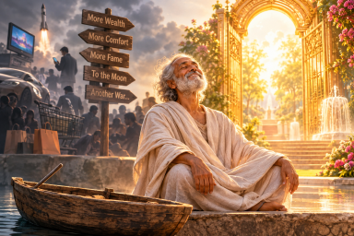
He is an empty boat, moving on the sea, not going anywhere.
Allow this point to penetrate deep into your heart. YET HE DOES NOT KNOW HIMSELF TO BE KIND AND GENTLE — because if you know, you have missed the point; if you know that you are a simple man, you are not. This knowledge makes it complex. If you know that you are a man of religion, you are not, because this cunning mind which knows is still there.
When you are gentle, and you don’t know, when you are simple, and you are not aware of it, it has become your nature. When something is really natural you are not aware of it, but when something is imposed, you are aware of it. When somebody becomes rich, newly rich, he is aware of his house, of his swimming pool, of his riches, and you can see that he is not an aristocrat, because he is so concerned with show.
A newly rich man ordered three swimming pools for his garden. They were made and he was showing them to a friend. The friend was a little puzzled. He said, “Three swimming pools? For what? One will do.” The newly rich man said, “No, how can one do? One for hot baths, one for cold baths.” His friend asked, “And the third?” He answered, “For those who cannot swim. So the third swimming pool is going to stay empty.”
You can see if a man has newly acquired wealth — he will be showing it. A real aristocrat is one who has forgotten that he is rich. A man of Tao is the aristocrat of the inner world.
If a person shows his religion he is not yet really religious. The religion is still like a thorn, it is not natural, it hurts, he is eager to show it. If you want to show your simplicity what type of simplicity is this? If you exhibit your gentleness, then it is simply cunning, nothing gentle exists in it.
A man of Tao is an aristocrat of the inner world. He is so attuned to it, there is no exhibition — not only to you, he himself is not aware of it. He does not know that he is wise, he does not know that he is innocent — how can you know if you are innocent? Your knowledge will disturb the innocence.
A man of Tao does not know himself to be kind and gentle. He IS gentle, but he doesn’t know; he is kind, but he doesn’t know; he is love, but he doesn’t know — because the lover and the knower are not two, the gentleness, the kindness, the compassion and the knower, are not two. No, they cannot be divided into the known and the knower. This is the inner aristocracy: when you have become so rich you are not aware of it. When you are that rich, there is no need to exhibit it.
A man of Tao is an aristocrat of the inner world. He is so attuned to it, there is no exhibition — not only to you, he himself is not aware of it. He does not know that he is wise, he does not know that he is innocent — how can you know if you are innocent?
Your knowledge will disturb the innocence.
It happened once that Henry Ford came to England. At the airport inquiry office he asked for the cheapest hotel in town. The clerk in the office looked — the face was famous.
Henry Ford was known all over the world. Just the day before there were big pictures of him in the newspapers saying that he was coming. And here he was, asking for the cheapest hotel, wearing a coat that looked as old as he himself.
So the clerk said, “If I am not mistaken, you are Mr. Henry Ford. I remember well, I have seen your picture.”
The man said, “Yes.”
This puzzled the clerk very much, and he said, “You are asking for the cheapest hotel, wearing a coat that looks as old as you yourself. I have also seen your son coming here, and he always inquires about the best hotel, and he comes in the best of clothes.”
Henry Ford is reported to have said, “Yes, my son’s behavior is exhibitionist, he is not yet attuned. There is no need for me to stay in a costly hotel; wherever I stay I am Henry Ford. Even in the cheapest hotel I am Henry Ford, it makes no difference. My son is still new, afraid of what people will think if he stays in a cheap hotel. And this coat, yes, this belonged to my father — but it makes no difference, I don’t need new clothes. I am Henry Ford, whatsoever the dress; even if I am standing naked, I am Henry Ford. It makes no difference at all.”
When you are really attuned, really rich in the inner world, you are not concerned with exhibition. When you first go to a temple, your prayer is a little louder than others. It has to be. You want to show off.
The showmanship is part of the ego, what you show is not the problem. You show, you exhibit. Then the ego is there, the boat is not empty — and a man of Tao is an empty boat. He is gentle, not aware; he is innocent, not knowing; he is wise, that’s why he can move as a fool, not worried. Whatsoever he does makes no difference, his wisdom is intact, he can afford to be foolish. You cannot. You are always afraid that somebody may think you a fool.
You are afraid that if others think you to be a fool, you will start suspecting it. If so, many people think you a fool your self-confidence will be lost. And if everybody goes on repeating that you are a fool, sooner or later you will come to believe it. Only a wise man cannot be deceived, he can appear as a fool.
Walk alone, but don’t take pride in it. Then you can move in the world without being a part of it. Then you can possess without being possessed by your possessions. Then the world is there outside, but not within. Then you are there, but not corrupted by it.
This is true loneliness — moving in the world without being touched by it.
Osho: The Empty Boat Chapter #2 Chapter title: The Man of Tao (Excerpts)
बिछड़ जाऊं तो फ़िर रिश्ता तेरी यादों से जोड़ूंगा,
मुझे ज़िद है, मैं जीने का कोई मौका न छोड़ूंगा।……………….वसीम बरेलवी
Bichchad jaaun to phir rishta teri yaadon se jodunga,
mujhe zid hai, mein jeene ka koi mauka na chhodunga………………Waseem Barelvi
Even if we drift apart, I shall keep our bond alive through memories.
For I am stubborn about living, I will leave no chance to embrace life unexplored.
There is a beautiful sense of longing in this song….O Re Piya — a yearning that seems to reach beyond words. Perhaps, beneath all our desires, ambitions and endless pursuits, there is another longing: a longing to simply be at ease with ourselves.
We spend so much of our lives seeking fulfilment in the world outside, keeping ourselves occupied with things that may not really matter. Yet, as Osho reminds us, the journey towards peace begins when we learn to let go of the non-essential.
As you listen to this beautiful rendition by Rahat Fateh Ali Khan, perhaps hear that longing not just as a call to a beloved, but as a call to discover the stillness within. (Film: Aaja Nachle | Music: Salim-Sulaiman | Lyrics: Jaideep Sahni)
O Re Piya…
O Re Piya | Full Song | Aaja Nachle | Madhuri Dixit | Rahat Fateh Ali Khan | Salim-Sulaiman, Jaideep