Everything that is of value is fragile. Beauty is fragile, silence is fragile, love is fragile.
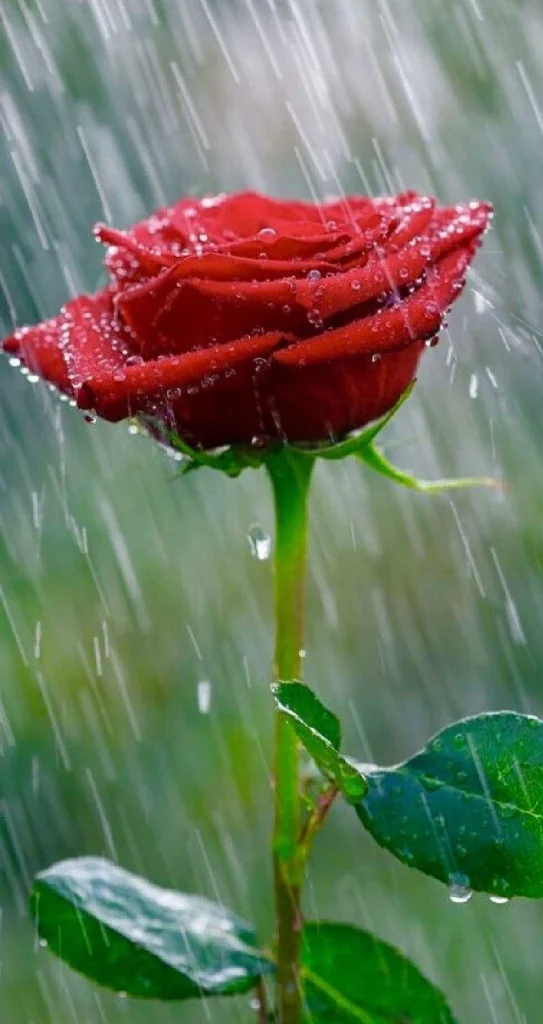
Look at a rose flower dancing in the wind, and in the rain, and in the sun. It seems it is strong enough for the wild wind, strong enough for the sun, strong enough for the rain. It is very fragile; by the evening, its petals will be thrown in all directions. But while it was, it was tremendous; while it was, it was more than any rock. The rock will remain, the rock is permanent; the flower will come and go. The higher the value, the more fragile it is.
One has to deeply understand it; otherwise you start clinging to great experiences, and you destroy those experiences by your very clinging. They are so fragile that your clinging can destroy them, your attachment can destroy them; even your desire to continue them can be poison, destructive, murderous to them.
As you become acquainted more and more with silence, peace, blissfulness, ecstasy, you will have also to learn the lesson: enjoy them while they are at their fullest, and when they go, let them go with a joyful and grateful heart.
Yes, tears are allowed but not tears of pain — tears of prayer, tears of gratitude. The more easily you let them go, the more those experiences come to you. And once you have understood the science that your let-go is the way to desire them, to long for them – not the desire, but a desire less love — one should feel blissful enough, even if a fragile experience visits you only once. If you are grateful, it is bound to come again and again.
Slowly, slowly, it may not go at all; it may become your very heartbeat. It can become your very breathing, but one has to learn the whole science.
Ordinarily, what our mind is going to do is to close the doors, close the windows, and keep the fresh breeze in, so that it cannot escape. But just by closing all the doors and the windows you have destroyed the freshness of the breeze; soon it will be stale. It will have lost its dance; it will have lost its aliveness; you will be sitting by the side of a corpse.
And people are sitting by the side of corpses — corpses of love, which they call marriages, corpses of prayer, which they call their temples, their churches, their mosques, and corpses of authentic and sincere experiences, which they call holy scriptures. People are surrounded by corpses. And if you keep company with corpses, you cannot remain alive very long yourself; you will become a corpse amongst other corpses. It is a very dangerous friendship.
Beware of it! Learn the simple fact that truth, love, beauty, bliss — all are very fragile, very momentary. You cannot grasp them in your fist; they are like fragrances. You cannot run after them. You have to wait and trust: the same existence that has brought an experience to you will bring many more. It is abundant, it wants to share, but it can share only with people who are not hoarders. It can share only with people who know the momentariness, the fragileness — and the beauty of fragileness, and the joy of momentariness.
Only dead things are permanent.
All that is alive is changing, moment to moment.
All that is alive is living under the risk of death at any moment. If you want to be secure, absolutely secure, then you will have to enter into your grave; only graveyards are absolutely secure places. In a grave, nothing else happens; everything stops, time stops, nothing changes anymore. Even death cannot do any harm to you.
But if you want to be alive, then more aliveness… the more you have to be alert and aware of the fragileness of all the qualities that are not created and manufactured by man, which descend from the beyond — unpredictable, out of nowhere, suddenly overwhelming you. Don’t think about whether they will remain or go, because if you get into thinking about your future, and the possibility of the experience remaining permanently with you, you may miss everything. Enjoy it, dance with it, let time cease.
Put the mind aside. Then even a single moment is equal to eternity.
Change is favourable to life. That’s why even death, I say, is favourable to life — because it is the greatest change. It brings you into new spaces, into new forms, into new existences; it keeps your pilgrimage continuously new, it keeps your excitement alive. Every moment remains always a challenge and a deep awaiting, because anything is possible. Silence can come to you, blissfulness can come to you, ecstasy can descend into your heart, truth can open its doors; life is full of mysteries, uncountable. So when it happens, be thankful — and move on.
And slowly, slowly, as you become more acquainted with the depth of silence, while you are working, doing something, the unknown guest may come suddenly and stand by your side.
A time comes when these experiences start following you like a shadow; just close by, you can feel their coolness, you can smell their fragrance. Just remember not to grab, not to possess, not to make the effort of changing them into your property. They come in freedom, and they remain in freedom. You cannot enslave them.
Somehow we have an unconscious desire for things to be permanent. Why this desire is in the unconscious, is something to be explored. Perhaps it is the fear of death. Most probably it is, because we are ourselves fragile. This moment you are alive, next moment you may be gone. Because of our own fragileness, we desire to have permanency in everything around us as a security, as a safety. But if we are fragile, how can our experiences be anything else?
Every moment, everything is changing. Our language gives us a very fallacious idea, because our language consists of nouns and pronouns, and existence knows only verbs.
When you see the river, the actual fact is that there is not a river; the actual fact is that there is a rivering, because the water is continuously flowing. A tree does not exist, there is only treeing, because the tree is continuously growing. And the same is the case with you. You won’t go back from this place the same as you have entered — so much water will have gone down the Ganges.
Gautam Buddha was the first man in history who reminded his disciples that existence consists only of verbs, not of nouns, not of pronouns. To make a language only of verbs, will be very difficult, almost impossible — conversation will become so ridiculous – so we have to continue to use nouns and pronouns. But remember, deep down, that there is nothing static.
Don’t be befooled by the language you use. Look around, everything is changing – every moment, every split second. And once you understand change as the God of existence, your whole life pattern — your attitudes, your approaches, your style — will change accordingly. You will become more of a flow than a dirty pond.
You will become more like a river, a pilgrimage into the unknown towards the ocean, where even you are going to disappear.
Osho: The Golden Future Chapter #30 Chapter title: Life is a deep interdependence Q 1. (excerpts)
महसूस कर रहा था उसे अपने आस पास
अपना ख़याल ख़ुद ही बदलना पड़ा मुझे…………………..अमीर क़ज़लबाश
mahsūs kar rahā thā use apne aas paas
apnā ḳhayāl ḳhud hī badalnā paḌā mujhe……………..AMEER QAZALBASH
I could feel them around me;
I had to change my own way of seeing.
“Har ghadi badal rahi hai roop zindagi…” encapsulate the essence of living fully, as tomorrow is uncertain. Life’s fragility becomes its beauty. As we live with awareness, embracing change as life’s only constant, every moment becomes a sacred pilgrimage – a journey of disappearing into the vast ocean of existence. Truly, life is precious because it is fleeting. Live, love, and flow with grace, for “kal ho naa ho.” (2003) Singer – Sonu Nigam, Music – Shankar Ehsaan Loy, Lyrics – Javed Akhtar
Kal Ho Naa Ho Full Video – Title Track|Shah Rukh Khan,Saif Ali,Preity|Sonu Nigam|Karan J