One day it happened that a great philosopher came to Buddha. Buddha was sitting under a tree. This man, Buddha, must have loved trees tremendously. He was always sitting under a tree. He became enlightened under a tree – although it is not such a big thing to become enlightened under a tree; many people have. But you will be surprised to know that Buddha was also born under a tree. And he died under a tree as well.
Although Buddha was a king’s son he was not born in a palace. His mother was travelling, and they came to a garden and suddenly she felt the pain arising. There was no other place, so she got down, stood under a tree and Buddha was born. Later he became enlightened under a tree and then, when he was dying, he again lay down under a tree and died under it.
He must have loved trees very much. For five hundred years after him the tree remained his symbol. For five hundred years no statue of him was made– just trees were painted. Trees were placed in temples and people worshipped the trees. In a way it was very beautiful.
I would like to remind you again– the tree is symbolic of religion because it grows. And it grows out of the innermost core.
Buddha was sitting under a tree and this great philosopher said, ’Have you said everything that you know?’ Buddha had become very old – almost eighty years old – and within a few months he would be gone. The great philosopher had come from a long way to enquire if he had said all that he knew.
And Buddha took a few dry leaves in his hand and asked the philosopher, ’What do you think, sir? How many leaves have I got in my hand? Are they more than the number of dry leaves in this forest?’
The paths, the whole forest, was full of dry leaves; the wind was blowing here and there, and the dry leaves were making much noise and much music. The philosopher looked and he said, ’What type of question are you asking? How can you have more leaves in your hand? You have only a few, a dozen at the most, and there are millions of leaves in this forest.’ And Buddha said, ’So remember. That which I have said is only like the few leaves in my hand. And that which I have not said is like the dry leaves in this forest.’
The philosopher said, ’Then one question more. Why have you not said that?’ Buddha said, ’Because it will not help you to attain nirvana, it will not help you to meditate – that’s why I have not said it. And moreover, it cannot be said. Even if I wanted to say it, it cannot be said. You will have to experience and know it. It is experiential, it is existential.’
The Master will say something only when he feels it is going to help your enlightenment. The Master will say something only when he feels you are ready to receive. The Master will say something only when he sees that clarity is there and the mind is open; that transparency is there and you are ready, with great humbleness and gratitude, to receive it. You are not quarrelsome, you are not ready to discuss and debate. Only in great sympathy, in great love, when the disciple is in rapport with the Master, can these things be transferred. These are delicate things.
This kindness is not of awareness. One has to be capable sometimes of not being kind. Great kindness is capable of being kind and of not being kind, both. Great kindness is capable of being hard too. If your kindness is such that you cannot be otherwise then it is not strength, it is weakness.
If you cannot act otherwise that simply means that you are fixed, you are not fluid. Sometimes it is necessary to be hard.
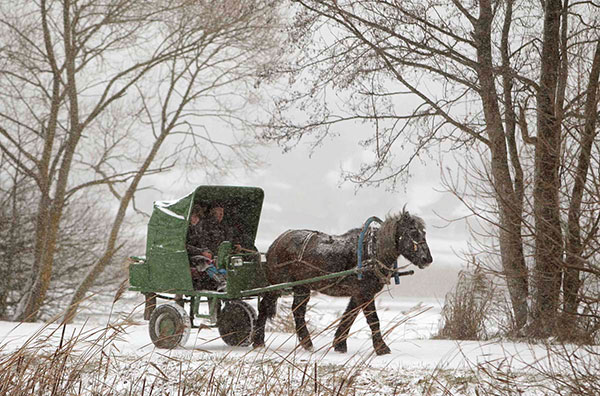
I have heard about a Zen Master who was driving a carriage with a woman and her child in it. Much snow was falling, and the morning was very cold and there was no sun in the sky, it was cloudy.
The Master started freezing and the woman in the carriage did too. By and by he saw that she was becoming blue and was losing consciousness. So he took away the child, pushed the woman out of the carriage and drove away.
The woman was shocked. She was left standing there in the falling snow, her child had been taken away – what type of man was this? And he had taken the carriage. She started running and shouting and screaming and cursing– and within half a mile, because of all the running and cursing and shouting and screaming, she was perfectly okay!
Then the Master stopped the carriage, took her in and said, ’Now it is okay. I had to do that otherwise you would have died.’
Sometimes to be really kind implies that you can be unkind too. If you cannot be unkind then your kindness is not of much worth. It is cultivated. It is not out of awareness.
Now think. If you had been that driver, you could not have done that. It looks immoral. But it is not. In the Zen tradition there are thousands of cases which look very immoral. Sometimes the Master jumps on the disciple, beats the disciple, throws him out of the window. And the story says he becomes enlightened – when he falls out of the window he becomes enlightened. To people who are not acquainted with the Zen methods it looks absurd. How can a person become enlightened like this?
But you must be made alert that the disciple may have been working for twenty years– meditating, working, meditating, working. And then one day the Master finds that only a thin layer of unawareness is left, a very thin layer. He watches the disciple, but he cannot get through that thin layer. Remember, when the unconsciousness is very thick you can fight with it but when it is very thin it is very difficult to fight with it. In fact, there comes a moment when it is so thin that you think it is not there. It is almost like transparent glass; it is so transparent you don’t see it. Then how can you fight it? Only the Master can see that you are still behind a glass. You are seeing very clearly, almost as if there is no glass, but still, you are behind glass.
In those moments the Master will be very hard. He will do something very shocking. In that shock that thin layer will be broken. And only when it is broken, not before, will you be able to know that some-thing was there in front of your eyes. When it is gone you will understand that a thin layer was there – a thin film which was so thin and so transparent that there was no way for you to know. Then you will feel thankful to the Master.
In Japan there exists a statue of Buddha, a very rare statue, of tremendous significance. One of my friends went to Japan where somebody gave him a replica, a plastic replica, of the statue. My friend is a Jain, and he could not understand it because it looked a little illogical and unhistorical.
In this statue Buddha has a sword in one hand. A sword? Buddha has never been known to carry a sword. He was not a Mohammed, neither was he a Krishna. A sword? But in this statue he has a sword in one hand.
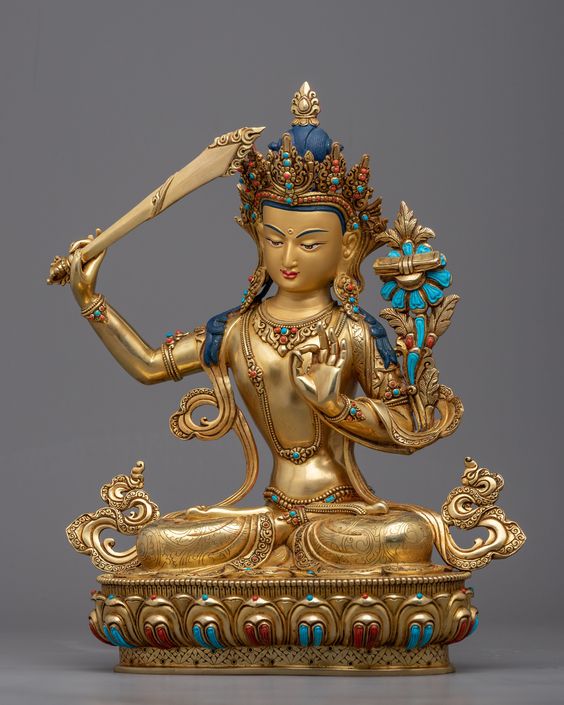
And the one side of his face is tremendously illuminated by the sword– and it does not look like the face of a Buddha, it looks like that of an Arjuna, a great warrior, a great soldier. The expression of the face has a sharpness to it.
In the other hand he is carrying a lamp, a small earthern lamp, and on that side of the face the expression is very quiet, very silent, very Buddha-like.
Now this is very absurd. When my friend came back from Japan and showed me the statue he said, ’I cannot understand it. What does it mean?’ I said, ’It is very meaningful. It is a Zen expression. It shows that your silence should be capable and strong also.’
The lamp of peace should be capable of becoming a sword any moment it is needed to be that way. And the sword should be capable of becoming a lamp of peace any moment it is needed to be that way. One should be fluid and all the polarities should meet in one.
A man is rich when all the polarities meet in him. When all the contradictions have lost their contradictions and have become friends, when you can befriend the contradictions, then you are really rich. This is the state of a religious man. The moral man chooses, the religious man lives in choiceless-ness.
Osho: Tao: The Pathless Path, Vol 2: CHAPTER 7. A TREE GROWS (excerpts)
उस जैसा यहाँ कोई भी फ़नकार नहीं है
क़ातिल है मगर हाथ में तलवार नहीं है………………अहमद सिद्दीक़ी
us jaisaa yahaa.n ko.ii bhii fankaar nahii.n hai
qaatil hai magar haath me.n talvaar nahii.n hai………………AHMAD SIDIQI
There is no artist here quite like him,
A killer he is, yet he holds no sword in hand.
Just as life alternates between harsh sunlight (dhoop) and the soothing shade (ghana saaya), true kindness emerges from embracing both strength and softness. The romantic song “Tum Ko Dekha To Ye Khayal Aaya” from the film “Saath Saath” (1982) beautifully captures this duality in relationships. It reminds us that love and kindness aren’t about perpetual ease but about the ability to provide comfort when needed and challenge when essential. Written by Javed Akhtar, composed by Kuldeep Singh and sung by legendary Jagjit Singh & Chitra Singh.
Really enjoyed reading this. The idea that the Buddha’s greatest strength was not force but wisdom and compassion is a powerful reminder. It made me pause and think about what true courage really means.
The symbolism of the ‘sword’ stayed with me long after I finished reading….
Also a great song again…I am a huge Jagjit Singh fan and this is one of my favourites.