
WHEN YOU TALKED ABOUT TRUST, TEARS WOULDN’T STOP COMING. YOU SAID YOU TRUST US, AND I FEEL SO UNTRUSTWORTHY. PLEASE COMMENT.
Trust is never conditional. I trust you, not because you are trustworthy; I trust you because I cannot distrust.
Once in India I was traveling from Indore to Kanva. Kanva was a big junction, and I had to wait there for one hour. I was alone in my air-conditioned compartment. A beggar knocked on the window, and I indicated to him to come in.
He came in. He said, ”My mother has died, and I don’t have even enough money to bury her.” I gave him one rupee. In those days that was even enough to get wood and burn your mother. The man looked surprised.
He was a professional beggar. I knew it, because I passed through Kanva many times, and it was always his mother who was dying. I could have asked, ”What a great mother you have got. Is your mother a Jesus Christ?” But I never said anything to him.
That day, thinking me mad or something, he came again. He said, ”My father has died.”
I said, ”Great! Take one rupee more.”
The man could not believe that so soon… just five minutes before his mother had died, now his father has died. And that gave him courage enough to come again after five minutes.
I said, ”Has your wife died?”
He said, ”How do you know? Yes.”
I said, ”Here is one rupee more. How many relatives do you have? Because it is unnecessarily disturbing me – these people will go on dying and you will have to come again and again. You just tell me the whole number, as if the whole family has died. How many relatives do you have?”
The poor man could not imagine more than ten. I said, ”Okay, you take ten rupees. And now, get lost.”
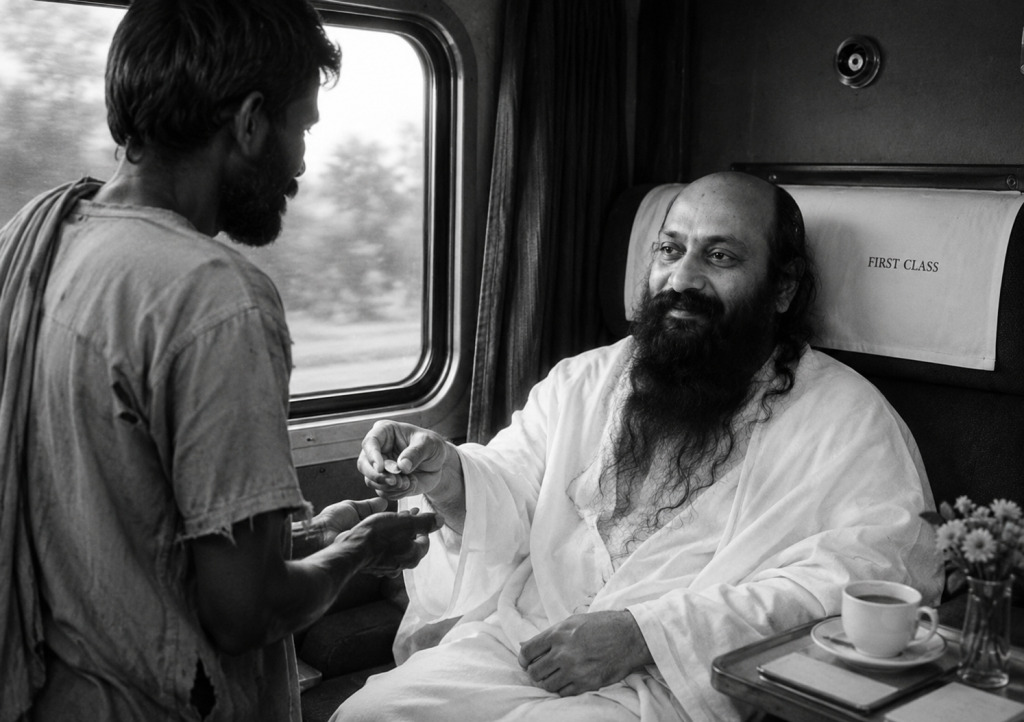
He said, ”Before I accept your ten rupees – three I have already taken – I want to know, do you believe me? So quickly my mother dies, my father dies, my wife dies, and now you are giving me an advance for my whole family.” He felt guilty that he was cheating. He said, ”No, although I am a beggar, I cannot cheat you. You still trust me?”
I said, ”You have done nothing wrong. I have money, you are poor; any excuse will do. And don’t you think that I am also immensely interested in your family? – because your mother has died many times before. I have been passing through this railway station so many times, and it was always your mother. How many mothers did you have?”
He said, ”I want one thing to be clear; otherwise I will carry this wound in my heart forever. How could you trust me?”
I said, ”I thought perhaps you went on forgetting that it is the same man you are asking for money: ‘My mother has died, my father has died, my wife has died.’ Perhaps you were thinking you were asking different people” – because he came with different clothes. One time he came with a cap, another time with a basket, the third time with a coat on – just so that he was not recognized as the same man.
I said, ”I was wondering if perhaps you could not recognize me as the same man. And as far as trust is concerned, I trust you still. It has nothing to do with your trustworthiness; I trust you because I cannot distrust. It is my incapacity; it has nothing to do with your worthiness or unworthiness.”
He returned the thirteen rupees. I tried hard to refuse but he said, ”No. I will not take these rupees knowing perfectly well that you are aware that I am cheating and still you trust me. You have given me the dignity of being a human being for the first time in my whole life. And I am not going to beg again – without saying a word, you have changed me.”
You say you could not stop the tears because I said I trust you, and you feel unworthy. That’s a great step, to feel that you are unworthy. It is a quantum leap. Those tears will take it away, wash you completely clean of your unworthiness. But as far as I am concerned, whether you are worthy or unworthy makes no difference to me: I trust you.
Questioning is irrelevant in religion. Trust is relevant. Trust means moving into the experience, into the unknown, without asking much — going through it to know it.
But that’s what you are asking: Convince us about God, then we will meditate, then we will pray, then we will search. How can we search before the conviction is there? How can we go on a search when we don’t know where we are going?
This is distrust — and because of this distrust you cannot move into the unknown. The known clings to you, and you cling to the known — and the known is the dead past. It may feel cozy because you have lived in it, but it is dead, it is not alive. The alive is always the unknown, knocking at your door. Move with it. But how can you move without trust? And even doubting persons think that they have trust.
Once it happened: Mulla Nasruddin told me that he was thinking of divorcing his wife. I asked, ‘Why? Why so suddenly?’
Nasruddin said, ‘I doubt her fidelity towards me.’
So I told him, ‘Wait, I will ask your wife.’
So I told his wife, ‘Nasruddin is talking around town and creating a rumor that you are not faithful, and he is thinking of divorce, so what is the matter?’
His wife said, ‘This is too much. Nobody has ever insulted me like that — and I tell you, I have been faithful to him dozens of times!’
It is not a question of dozens of times — you also trust, but dozens of times. That trust cannot be very deep, it is just utilitarian. You trust whenever you feel it pays. But whenever the unknown knocks you never trust, because you don’t know whether it is going to pay or not. Faith and trust are not a question of utility — they are not utilities, you cannot use them. If you want to use them, you kill them. They are not utilitarian at all. You can enjoy them, you can be blissful about them — but they don’t pay.
Trust is a miracle. If you trust even the person who is going to murder you, his sword will fall from his hands. If you trust the man who is going to shoot you, there is every possibility he may shoot himself. Trust is a tremendous power. Distrust makes you weak.
And how many people are you going to distrust? The whole world? That’s what you have been told and taught: never trust anybody; otherwise you will be cheated. But it is better to be cheated than to lose your immense power of trust. And what can you be cheated of? In fact, the people who have told and taught you, ”Never trust people because they will take advantage of it,” are your enemies.
They have destroyed your greatest power.
Trusting unconditionally, you will be relieved of the burden…. Such a big burden you are carrying on your heart, a Himalaya, because there are so many millions of people you have to distrust.
Machiavelli, the only significant political philosopher of the West, writes in his masterpiece THE PRINCE:”Don’t trust even your friend, because tomorrow he can become your enemy, the possibility is there.” He also says, ”Don’t say things against your enemy, because tomorrow he can become your friend.” These are the teachings he was giving to the princes from all over Europe. Princes were being sent to Machiavelli to learn politics, diplomacy, how to rule over people, how to conquer new lands, how not to be invaded.
I always wanted to ask Machiavelli about all these princes whom he had been teaching….” No prince, when he became king, accepted Machiavelli as his prime minister. He applied again and again. Those were his own students; now they had become kings, and he wanted to become their prime minister.
It seems so logical that the prince would like his own wise teacher to become his wise adviser. But none of his disciples accepted him, they all refused. They said, ”You are too cunning, too clever; we cannot trust you. And this is according to your teaching. We are simply following the dictums that you have given to us. We don’t want to lose our kingdom”– because if Machiavelli is prime minister today, tomorrow he will be the king. Machiavelli died a pauper, poor– and he was the teacher of almost all the kings of Europe!
You teach people to distrust that means you are teaching them to distrust you too.
I trust you, with no conditions attached to it
That is my difficulty, that is my problem; I have never distrusted anybody. I cannot, because I know the beauty of trust, the enormous blissfulness of trust. I cannot lose that blessedness by mistrusting, distrusting anybody. I cannot lose my Kingdom of God just because you are unworthy of trust. That is your trouble. Why do you want to create trouble for me?
No, life cannot be that cheap. Trust cannot be that cheap. Love cannot be that cheap; one has to stake one’s whole soul for it. Never try to cultivate trust; never try to make trust function, because that will be belief. Drop doubt. Enter into doubt; realize the futility of doubt; realize the futility of thinking and try to come to a state of no-mind; and then trust arises. You simply remove the hindrances.
Nothing positive is needed to be done, only something negative: something has to be removed. When the passage is clear, trust flows. You melt and you start flowing.
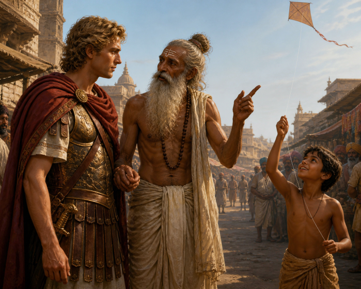
It happened that when Alexander came to India he met a sannyasin, a great sage.
The sage’s name was Dandamis; that is how Greek historians have pronounced it. Alexander asked him, “Do you believe in God?” The sage remained silent.
Alexander said, “I cannot see, so how can I believe? How do you believe without seeing him?” The naked sage laughed. He took Alexander by his hand towards the marketplace. Alexander followed — maybe he was taking him somewhere where he could show him God. A small boy was flying a kite, and the kite had gone so far away that it was impossible to see it. The sage stopped there, and asked that boy, “Where is the kite? Because we cannot see it, and without seeing how can we believe? Where is the kite? How do you still believe that the kite exists?” The boy said, “I can feel the pull of it.” And the sage said to Alexander, “I can also feel the pull of it.”
Trust is nothing but the feel of the pull. You don’t see — one has never seen God; only the pull is felt. But that is enough, that is more than enough. But then you have to be in a certain state where the pull can be felt. It cannot be learned from scriptures; it is not a doctrine. Nobody can explain it: you have to feel the pull.
The old sage laughed. Alexander also realized that it had been a revelation. But the sage said, “Wait; no need to believe in me. You take the thread in your hand and feel the pull, because who knows? This boy may be deceiving. Never believe.
Feel the pull.” If Alexander had gone away just listening to the boy, it would have been a belief But he felt the pull: the kite was there on the other end, the pull was here on this end. He could feel the force. He thanked the old sage.
Osho: From Death to Deathlessness : CHAPTER 6. WAIT AND YOU SHALL FIND Q 2 (excerpts)
Osho: And The Flowers Showered Chapter #8 Chapter title: Tozan’s five pounds (excerpts)
उस मय से नहीं मतलब दिल जिस से है बेगाना
मक़्सूद है उस मय से दिल ही में जो खिंचती है……………..अकबर इलाहाबादी
us mai se nahīñ matlab dil jis se hai begāna
maqsūd hai us mai se dil hī meñ jo khiñchtī hai…………..Akbar Allahabadi
True intoxication is not what overwhelms the mind from outside,
but what irresistibly draws the heart from within.
These beautiful lines come from the soulful ghazal “Hungama Hai Kyon Barpa, Thodi Si To Pee Li Hai…” immortalized by Ghulam Ali ji. I find them particularly relevant here because they give the title “Feel the Pull” a poetic anchor. The “pull” in Osho’s story, the “खिंचती है” in Akbar Allahabadi’s couplet, and the “मय” of the ghazal all point toward the same inner movement — an invisible attraction drawing us toward truth, love, awareness, and awakening. Please listen and enjoy…
Ghulam Ali: Ghazal: Hungama Hai Kyon Barpa: Lyrics: Akbar Allahabadi
Absolutely! Great opening lines! We trust because we cannot distrust. Trusting is innate to human nature not distrusting. That’s why those who are suspicious by nature are treated as suffering from paranoia.