We live in a world that worships speed.
Faster decisions, quicker responses, instant reactions.
But what if the real superpower is not speed…
but the ability to pause?
There is a powerful story of George Gurdjieff and his unusual method of meditation.
Gurdjieff was doing far higher work. He found a simple way of stopping the mind. In the East people have been trying for centuries to concentrate the mind, to visualize it, to stop it – and Gurdjieff found a way through physiology. But it was not his discovery, he had just found what those nomads had been doing all along.
Gurdjieff would shout ”STOP!” and everybody would freeze. And when the body suddenly freezes, the mind feels a little weird: What happened? – because the mind has no association with the frozen body, it is just shocked. They are in cooperation, in a deep harmony, moving together. Now the body has completely frozen, what is the mind supposed to do? Where can it go?
For a moment there is a complete silence; and even a single moment of complete silence is enough to give you the taste of meditation.
Gurdjieff had developed dances, and during those dances suddenly he would say ”Stop!” Now, while dancing you never know in what posture you are going to be. People would simply fall on the floor.
But even if you fall, the exercise continues. If your hand is in an uncomfortable position under your body, you are not to make it comfortable because that means you have not given a chance for the mind to stop. You are still listening to the mind. The mind says, ”It is uncomfortable, make it comfortable.” No, you are not to do anything.
The body had stopped… but the mind, used to continuous movement, suddenly had nowhere to go.
For a brief instant, it was shocked into stillness.
And in that gap –
there was silence.
Even if it lasted just a moment, it gave a glimpse of something deeper… a taste of awareness beyond thought.
While Gurdjieff used a sudden shock to create stillness, life often offers us gentler invitations to pause – if we are willing to notice them.
I was reminded of one such beautiful story narrated by Prakash Iyer – Leadership Trainer, Motivational Speaker and a bestselling Author.
And I quote:
“One of my favourite memories as a little kid is going out and watching cricket on the maidans of Mumbai. So I’d be out there watching time shield matches in Cross maidan or Azad maidan and go and watch some first-class cricket at one of the stadiums in Mumbai.
And I remember how in one particular match I happened to have access to the area where players and the officials were and while everybody was trying to get an autograph from the cricketers, I went across to the Umpire to get an autograph.
And this wasn’t just another Umpire, it was someone who had become quite a legend in those times. And I am talking about Swaroop Kishen.
Swaroop Kishen was a lawyer and a very nice Umpire, but he was also famous for being fairly obese. So you will often see a Hardy when the two Umpires went out to the game.
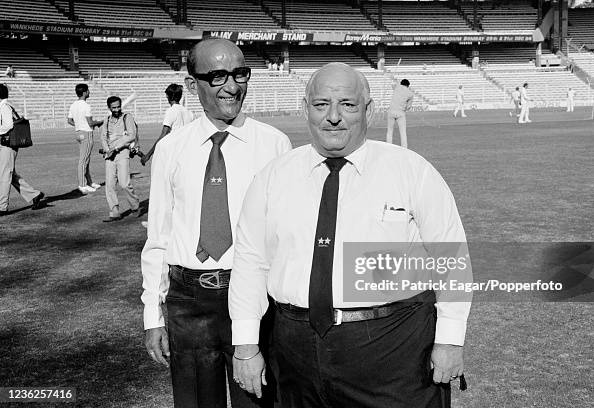
What’s interesting of course was when I asked Mr. Swaroop Kishen for an autograph, he took my little autograph book and wrote something before signing, and he wrote three words. He wrote –“Pause and Decide” and then signed Swaroop Kishen.
And I thought that was quite an innovative little bit or a novel little bit because most cricketers would just scribble something and here was a man who took the time to write a message. And then I asked him, he just smiled and he said, “I’ve learned one lesson as an Umpire, never rush it. Because when you pause before the decision, you will suddenly see a world of information opening up. You will find an expression on the batter’s face which will tell you whether he nicked it or not. You will see the wicketkeeper shake his head and it will tell you whether the catch was clean or not. And he said, “just learning to pause before a decision is such a superpower.”
I think, for the rest of my life, I have kind of taken that advise to heart. I think it’s such a great idea for all of us to learn to pause. We live in an era where we all are in a hurry. Everything has to happen in two minutes. It’s not just the noodles, and we all want to be quick, and we think speed is a superpower. Speed is good but learning to pause even better.
The pause allows you to get a new information. The pause allows you to frame your response and it makes sure you don’t say something in a hurry which you will regret at leisure. So just learn to pause. I think, Swaroop Kishen’s advise is great for Umpires, it’s even better for all of us. Just remember – Pause and Decide.” – – Unquote
Two very different worlds.
A mystic’s meditation hall… and a cricket field.
And yet, the principle is the same.
When we pause, something shifts.
We move from reaction to awareness.
From impulse to insight.
From noise… to clarity.
In our daily lives, we may not hear a master shout “Stop!”
But life gives us countless moments where we can choose to pause –
before we respond, before we decide, before we react.
And in that small, almost invisible gap,
lies a different kind of intelligence.
Maybe the next time life pushes us to go faster,
we should remember something deeper.
Not everything valuable comes from speed.
Some of the most important things in life –
clarity, wisdom, awareness –
arrive only when we pause.
Pause.
And then decide.
————————————————-
Osho: From Personality to Individuality: CHAPTER 9. THE LAW OF KARMA: A CONSPIRACY OF THE PRIESTS TO MANIPULATE YOUR MIND
Perhaps that is the thread connecting both stories. Gurdjieff’s emphatic “Stop!” was not meant to halt life, but to awaken awareness. Swaroop Kishen’s “Pause and Decide” was not about delaying action, but about seeing clearly before acting. In both cases, the pause was not the destination—it was the doorway.
A beautiful Gujarati couplet captures this wisdom with remarkable simplicity:
સિગ્નલો પર શબ્દ બે વંચાય,
“थांबा आणि झा”
જિંદગીનો ભેદ અહીં પરખાય,
.”थांबा आणि झा”………………………..
“सिग्नल पर दो शब्द नज़र आते हैं…
“थांबा आणि झा”
ज़िंदगी का राज़ भी यहीं समझ आता है
“रुको और जाओ।”
At every signal, two simple words appear—Stop and Go. And in them lies life’s quiet wisdom: knowing when to pause, and when to move.
Perhaps that is also why the song “Theher Ja” from the film “October” touches a deeper chord within us. Life is constantly urging us to move, achieve, respond, and race ahead. Yet somewhere beneath the noise, there is a gentle whisper asking us to pause, to linger for a moment, to become fully present before taking the next step. These lines of the song are relevant here,,,”Theher ja…” → Pause, stay, don’t rush away “Tu kisi bahaane se” → Even if you need an excuse… just pause. The rest of the song expresses a state of being immersed, slowed down, present.
Sometimes, wisdom is not found in movement. Sometimes, it is found in the pause. Sometimes, life simply says—”Theher Ja.”
(Singer – Armaan Malik, Music – Abhishek Arora, Lyricist – Abhiruchi Chand)
Theher Ja | October | Varun Dhawan & Banita Sandhu | Armaan Malik | Abhishek Arora | Abhiruchi Chand
Wonderful post Rajiv Bhai…..
Totally resonates, it is important to take deliberate pauses and hear your own breathing and your own thoughts rather than being in forever ‘action’ mode.
Also lovely song – heard this for the first time. Thanks for sharing.
Thanks for so wonderfully capturing the beauty of a pause. We need to do it more often esp in current times of being over stimulated and rushing for instant gratification in every little thing we do.
I recently heard a nice recommendation esp to move from reaction to response ..The space between stimulus and response ask the 3 Qs
Does this need to be said/done?
Does this need to be said/ done now?
Does this need to be said/ done by me?
Move ahead with the “how” only if the answer to all 3 is a yes.